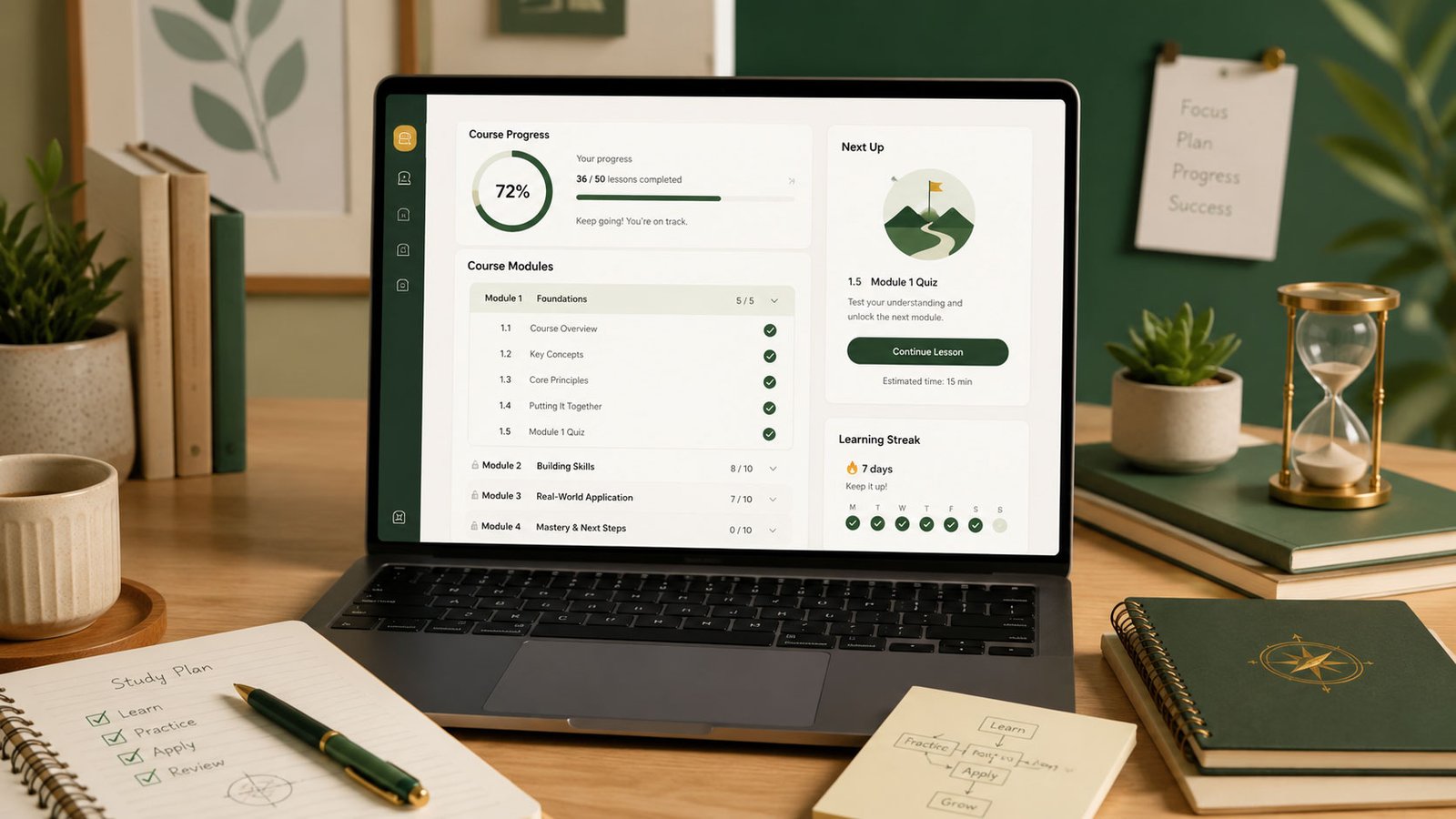

Many online courses start with excitement. A student enrolls, watches the first few lessons, takes notes, and imagines the results they want to achieve.
Then life gets busy.
They miss a lesson. They forget where they stopped. They open the course again and feel unsure what to do next. Before long, the course becomes another unfinished tab, saved for “later.”
This is one of the biggest challenges in online education. Students do not usually quit because they do not care. They quit because the path becomes unclear.
A strong course experience makes progress feel obvious.
When students log in, they should immediately understand where they are, what they have already completed, and what step comes next. That simple sense of direction can make the difference between a student who finishes and a student who disappears.
A clear learning path begins with structure. Instead of uploading random videos into one long list, organize your course into focused modules. Each module should represent one stage of the student’s journey.
For example, a course about building an online learning platform might include modules like:
Planning Your Course Offer
Creating Your Lesson Structure
Recording Your First Video Lessons
Setting Up Membership Access
Launching to Your First Students
Each module has a purpose. Each lesson supports that purpose. The student can see how the pieces connect.
This also helps instructors teach with more confidence. When your course is structured around outcomes, you do not have to include everything you know. You only need to include what helps the student move forward.
That is important because more content does not always create a better course. Sometimes too much content creates confusion. Students need enough information to act, not so much information that they feel overwhelmed.
The best lessons are usually focused and practical. Teach one concept. Show one example. Give one next step.
Students also benefit from checkpoints. A short recap, a worksheet, a discussion prompt, or a live coaching session can help them pause, reflect, and apply what they learned before moving on.
Community can strengthen this process even more. When students can ask questions, share progress, and see that others are learning alongside them, the course feels less isolated. They are not just watching videos. They are participating in a guided learning experience.
This is why a complete academy platform is so valuable. It brings the lessons, resources, coaching, and community into one place. Students do not have to search through emails, separate video links, scattered documents, and disconnected chat tools.
Everything supports the same learning path.
When students know what to do next, they are more likely to keep going. When they keep going, they are more likely to finish. And when they finish, they are more likely to get results.
A clear course structure does not just make your content look more professional.
It helps your students succeed.
Be the first to comment.